
Hammered mat
A versatile anti-slip solution for workshops, industrial settings and modern interiors
Hammered mat is one of the most sought-after types of technical rubber flooring and protective surfaces.
Thanks to its high resistancei, anti-slipm properties and modern appearance, it is used in industry, workshops, service vehicles and designer interiors.
The characteristic texture, reminiscent of slightly raised circles or a ‘hammered’ surface, ensures safe movement of people, protects the floor and guarantees the material’s long service life.
It is precisely this combination of functionality and aesthetic appeal that makes the hammered sheets a highly versatile solution.
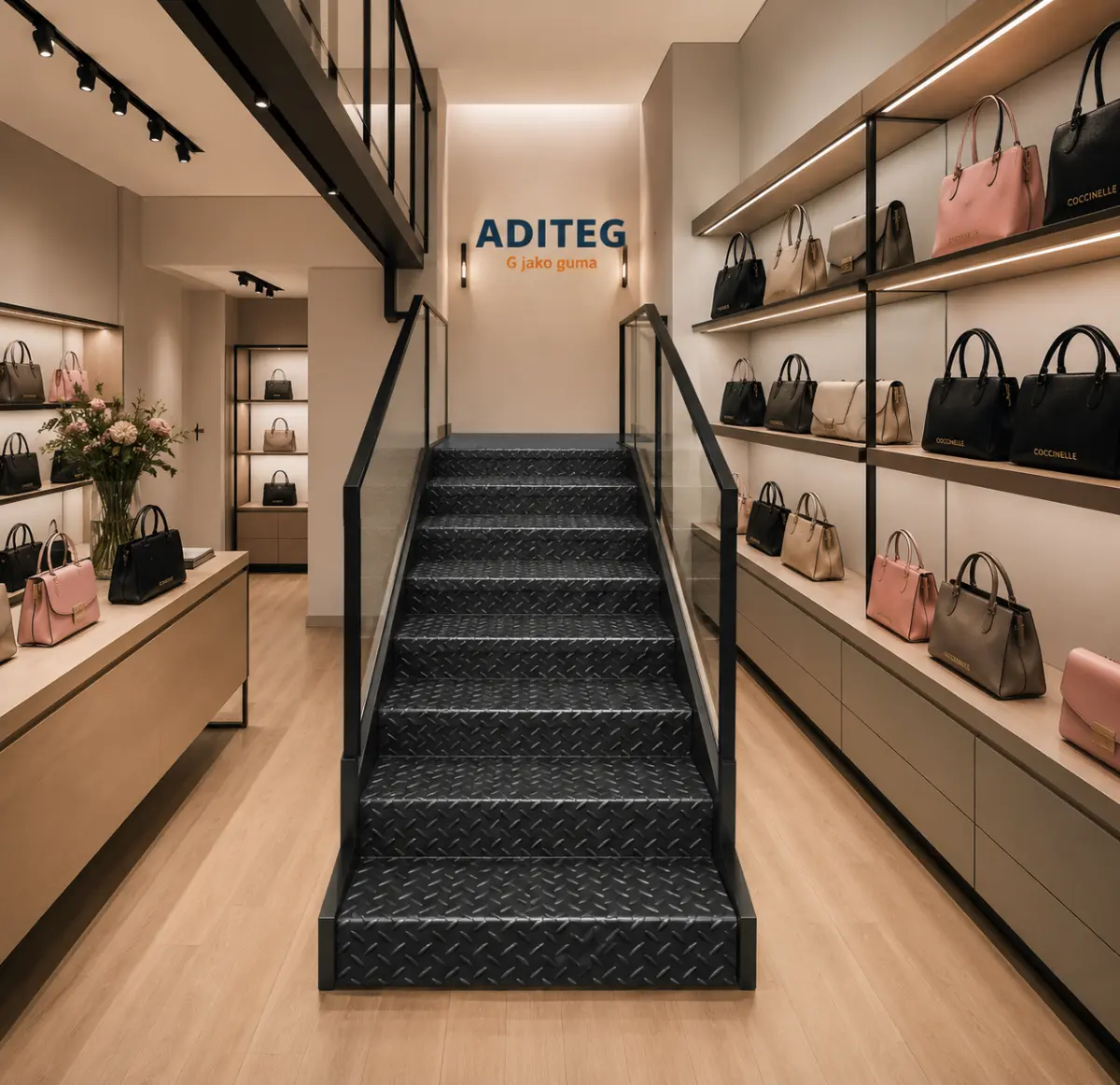
What is hammered mat?
Hammered mat is rubber or PVC flooring with a distinctive anti-slipm surface. It is most commonly produced in rolls or sheets of various thicknesses and is used where there is a need to:
- improve safety of movement,
- protect the floor from damage,
- reduce noise and vibrations,
- ensure easy maintenance,
- extend the service life of work surfaces.
Thanks to its construction, the material is highly resistant to mechanical stress, moisture and common chemicals.
Key benefits of the hammered sheets
Anti-slip surface
The embossed texture helps reduce the risk of slipping, even under heavy use. This is particularly important in workshops, warehouses or service areas.
High resistance
Hammered mat resistance:
- abrasion,
- pressure,
- vibration,
- moisture,
- normal operational loads.
It is therefore often used in industrial settings or on lorries.
Easy maintenance
The surface can be easily cleaned using standard cleaning products. The material does not require complex maintenance and retains its appearance over the long term.
Protection for floors and work surfaces
Hammered mat protects original surfaces from damage, scratches and vibrations caused by machinery and tools.
Modern, technical look
The black rubber texture looks professional and elegant. The material is therefore increasingly used in modern interiors and designer commercial spaces.
Where is hammered mat used?
Workshops and service centres
One of the most common uses. Hammered mat is used:
- on workbenches,
- under machinery,
- as flooring,
- in service bays.
It helps to protect work surfaces and improves safety.
Lifts
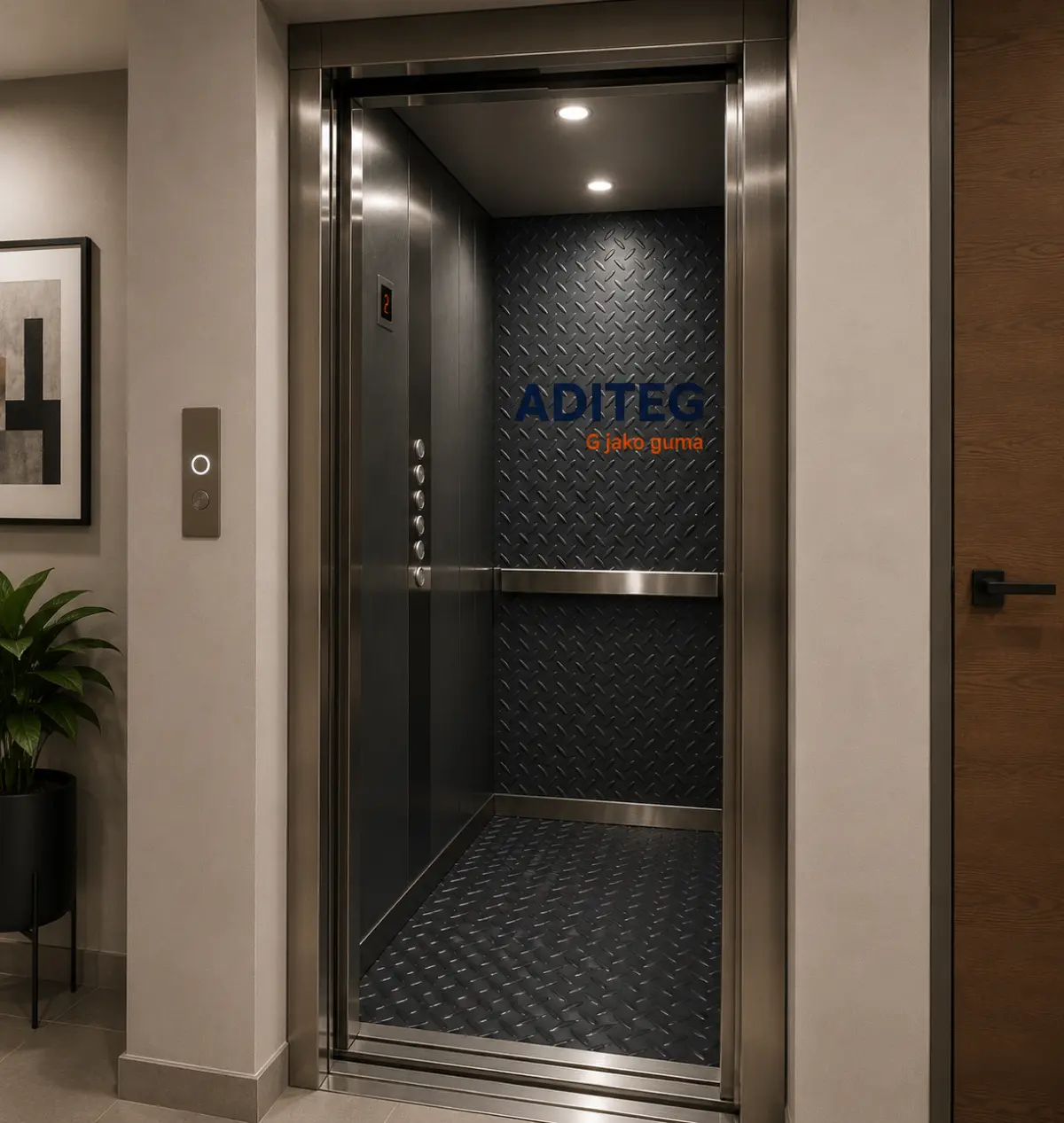
Modern lifts often use hammered steel panels as a durable and stylish flooring option. The material effectively dampens impact noise and withstands heavy use.
Lorries and commercial vehicles
Sheet protects vehicle floors from damage whilst preventing the cargo being transported from shifting.
Industrial premises
A suitable solution for:
- warehouses,
- production halls,
- utility rooms,
- logistics centres.
Retail and commercial premises
Thanks to its modern appearance, it is also used in:
- showrooms,
- luxury shops,
- industrial interiors,
- designer staircases.
How to choose the right hammered panel?
When making your choice, we recommend considering several para rubber metres:
Thickness of the material
- 3 mm – light-duty
- 4–6 mm – standard industrial use
- greater thicknesses – extreme loads
Material type
- rubber sheet – higher resistance and elasticity,
- PVC variant – lower weight and easier installation.
Slip resistance
For heavy-duty use, we recommend a more pronounced texture and higher slip resistance para rubber values.
Installation method
Hammer-fixed tiles can be:
- laid loose,
- glued,
- mechanically fixed.
Why is hammered mat also popular in modern design?
The industrial style is becoming increasingly popular. Today, technical materials are not just a functional solution, but also a striking design feature.
Hammered mat gives the impression of being:
- robust,
- minimalist,
- professional,
- luxurious when combined with metal, glass and black elements.
That is why architects are increasingly using it in modern interiors, showrooms and commercial projects.
Interesting facts about the production of the sheets hammer
The production of hammered sheets is technologically far more interesting than it might appear at first glance. Behind its simple technical appearance lies a precise combination of chemistry, pressure, temperature and material processing, which determines the final quality, elasticityi and service life of the product.
How is the characteristic hammered surface created?
The characteristic hammered sheets texture does not arise by chance. The surface is created using special rollers or moulds, which press a regular pattern into the material during production.
This process serves several important functions:
- it improves slip resistance,
- drains water and dirt,
- improves abrasion resistance,
- and reduces the visibility of surface damage.
It is thanks to this technology that sheet retains its good appearance even under long-term stress.
Manufacture under high pressure and temperature
Hammer-type sheets are most commonly manufactured by vulcanisation or calendering.
Vulcanisation
During vulcanisation, rubber is heated under high pressure. This alters the molecular structure of the material, resulting in:
- elasticity,
- strength,
- long service life,
- resistance resistance to deformation.
The temperature during production may exceed 150 °C.
Calendering
For PVC variants, the material is extruded between special rollers, which determine:
- thickness,
- texture,
- the final surface finish.
Manufacturing precision is often in the order of tenths of a millimetre.
Why do high-quality sheet last for years?
The service life of hammered sheets is significantly influenced by the composition of the mixture. High-quality manufacturers use:
- industrial-grade rubber,
- SBR or NBR compounds,
- UV stabilisers,
- plasticisers,
- protective anti-ageing additives.
As a result, the material:
- does not crack,
- does not harden,
- does not lose elasticity,
- and is resistant to oils and moisture.
In industrial applications, the service life can exceed 10 years of intensive use.
Each thickness has a different application
During production, the hardness and density of the material are also adjusted.
For example:
- softer sheets absorbs vibrations better,
- harder variants can withstand heavy machinery loads,
- thicker sheets protects the substrate against impacts.
That is why different types are used:
- in lifts,
- on workbenches,
- in service vehicles,
- or in production halls.
Modern manufacturing also takes the environment into account
Today’s manufacturers are increasingly using:
- recycled rubber,
- eco-friendly compounds,
- low-emission production,
- reprocessing of production offcuts.
This helps to reduce the environmental footprint of production without compromising on quality.
Interesting fact: a material also used in motorsport
Similar technical rubber surfaces are used:
- in motorsport service areas,
- in lorries,
- in military vehicles,
- in industrial facilities subject to extreme loads.
The reason is simple — the combination of:
- resistancei,
- safety,
- easy maintenance,
- and a long service life.
A design trend of recent years
Hammered mat has long since ceased to be merely an industrial material. Architects now also use it:
- in modern showrooms,
- luxury shops,
- industrial offices,
- designer staircases,
- or in the lifts of premium buildings.
The technical look has become part of the modern industrial style.
| +420 515 320 023 | ||
|
Mon–Thu 6:30–15:30 Fri 6:30–13:00 Lunch break 11:30–12:00 |
||
| [email protected] |
|
ADITEG, s. r. o. Vrbovec 321, 671 24 Znojmo |
