
Floor rubber
Rubber flooring: a modern solution for noise and vibration damping, as well as substrate protection
A highly functional and durable solution for spaces where emphasis is placed on longevity, safety and comfort.
Thanks to their properties, they are used not only in industrial facilities but also, increasingly, in homes, fitness centres and commercial premises.
The main advantage of rubber flooring is its ability to absorb vibrations and dampen noise. This makes it the ideal choice, for example, for use beneath heavy machinery, gym equipment or appliances such as washing machines and dryers.
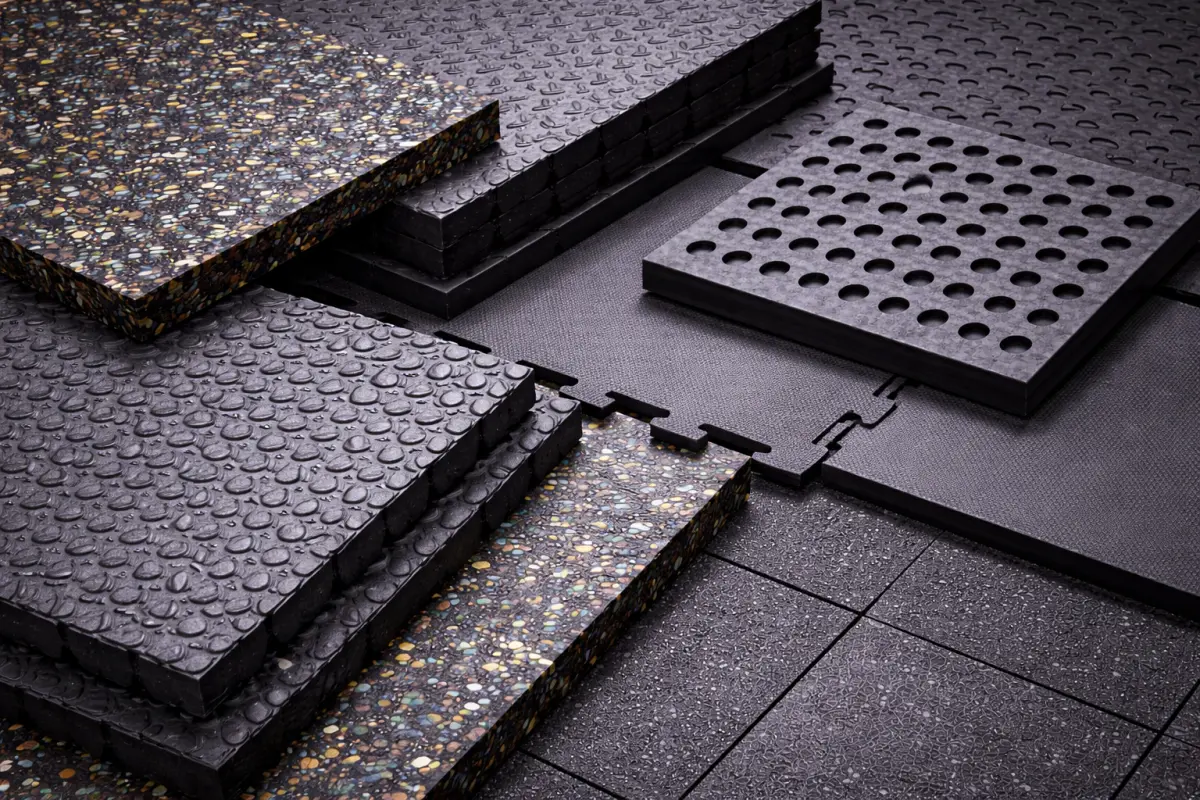
🔧 Types of rubberch flooring by application
🔹 Rubber granulate flooring
Made from recycled rubbere, often containing multicoloured particles. They offer excellent shock absorption and are affordable.
🔹 Solid rubber flooring
A homogeneous, high-density material. Ideal for industrial settings, workshops or areas subject to extreme loads.
🔹 Puzzle and modular rubber flooring
Easy to install without adhesive. Suitable for fitness centres or home gyms.
🔹 Textured rubber flooring
A dimpled or perforated surface ensures better water drainage and greater slip resistance.
🏠 Where rubber flooring is most commonly used
Rubber flooring has a wide range of applications:
- fitness centres and home gyms
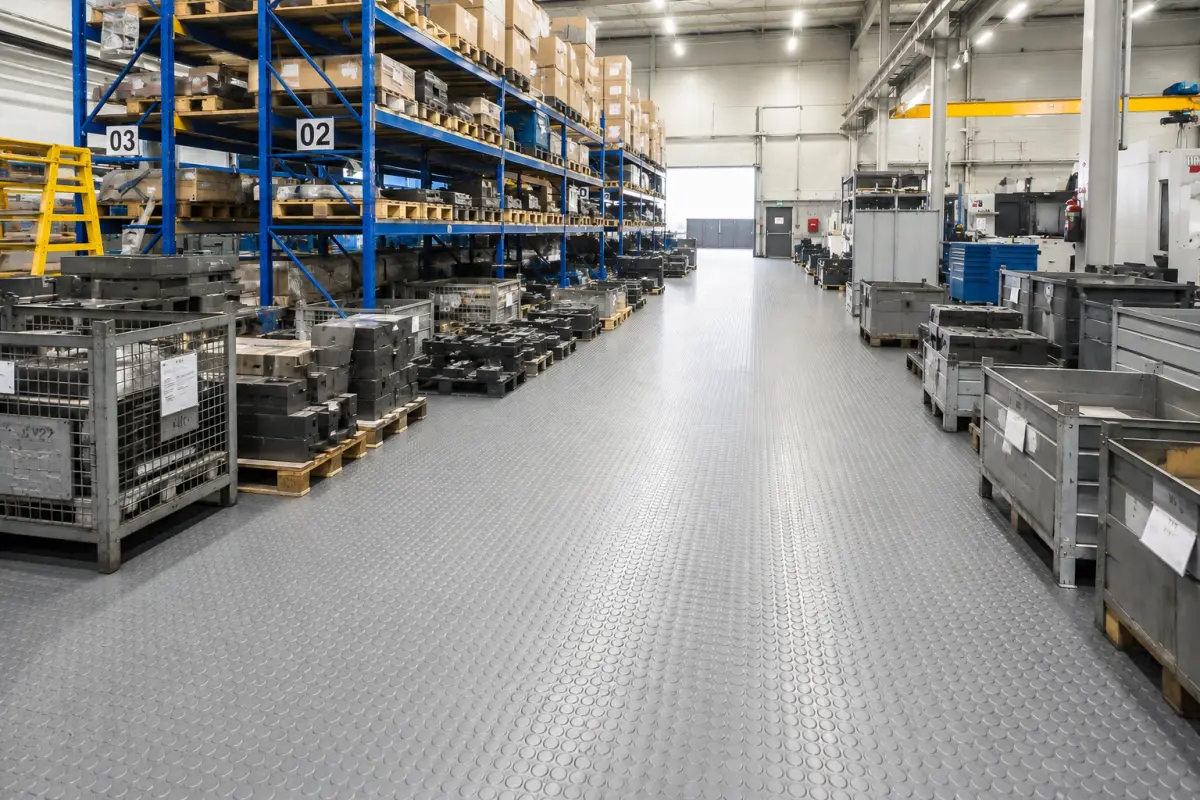
- industrial halls and workshops
- warehouses and logistics centres
- garages and utility rooms
- homes (under appliances or furniture)
Thanks to their versatility, rubber floors are one of the most practical solutions on the market.
🚀 Rubber flooring as an investment in comfort
Using rubber flooring is not just a matter of protecting the subfloor. It is a comprehensive solution that enhances comfort, safety and the lifespan of equipment. Rubber flooring effectively eliminates vibrations, reduces noise and, at the same time, protects the floor from mechanical damage.
Interesting facts about the production of rubberch flooring
The production of rubber flooring is a technologically fascinating process that combines recycling, materials chemistry and precision moulding. Although the end product appears simple, its creation involves a relatively complex manufacturing process.
♻️ Most rubber flooring is made from recycled materials
One of the most interesting aspects is that large of rubber flooring is made from recycled tyres. These are first mechanically crushed into rubber granules of various sizes.
👉 The result:
- an eco-friendly product
- reduced waste
- lower production costs
The coloured ‘dots’ visible on some floors are not just a design feature – they are a mixture of various recycled materials.
🔥 High-pressure and high-temperature moulding
Rubber flooring is not produced by ‘casting’, but by moulding. A mixture of granules and binder is:
- poured into a mould
- subjected to high pressure
- heated to a precisely specified temperature
This results in what is known as vulcanisation, during which the material bonds into a solid, homogeneous structure.
👉 As a result:
- the flooring retains its shape
- it does not disintegrate
- it has a high resistance
⚙️ Different surface finishes are created during the moulding process
The structure of the rubber flooring (nubs, perforations, grooves) is not added later, but is created directly during production.
The mould (moulding tool) determines:
- slip resistance
- water drainage
- pressure distribution
This means that every type of surface has a functional purpose, not just an aesthetic one.
🎯 Material density = key para rubbermetre
It is not just about thickness, but mainly about density. This is precisely controlled during production:
- higher density → higher load-bearing capacity
- lower density → better vibration damping
Manufacturers therefore adjust the composition of the compound according to the specific application (fitness, industry, children’s playgrounds).
🌈 Colouring isn’t just about appearance
The colour variations of rubberch flooring are created by adding pigment directly to the mixture or by combining different granules.
Interesting fact:
- the colour runs throughout the material, not just on the surface
👉 so the floor won’t wear down to reveal a different colour
🧩 Modular systems = precision manufacturing
Puzzle or tile systems must be extremely precise. Deviations are measured in millimetres; otherwise:
- they wouldn’t fit together
- gaps would form
- the floor would not be stable
Production therefore uses precision moulds and quality control for every piece.
🧪 Resistance resistance to chemicals and moisture
During production, additives are added to ensure:
- resistance resistance to oils
- resistance resistance to water
- UV stability (for outdoor use)
This is why rubber flooring can withstand even the most demanding conditions.
| +420 515 320 023 | ||
|
Mon–Thu 6:30–15:30 Fri 6:30–13:00 Lunch break 11:30–12:00 |
||
| [email protected] |
|
ADITEG, s. r. o. Vrbovec 321, 671 24 Znojmo |
