
Cords – solid circle profiles
circle cords with profiles for industrial and technical applications. High resistance, precise dimension and bespoke manufacturing.
A reliable solution for seal and technical applications
Solid circle profiles cords are among the fundamental components in the field of seal and technical materials. Thanks to their simple design, high versatility and wide range of materials, they are used in industry, construction and engineering.
In this article, we will look at their properties, uses and advantages.
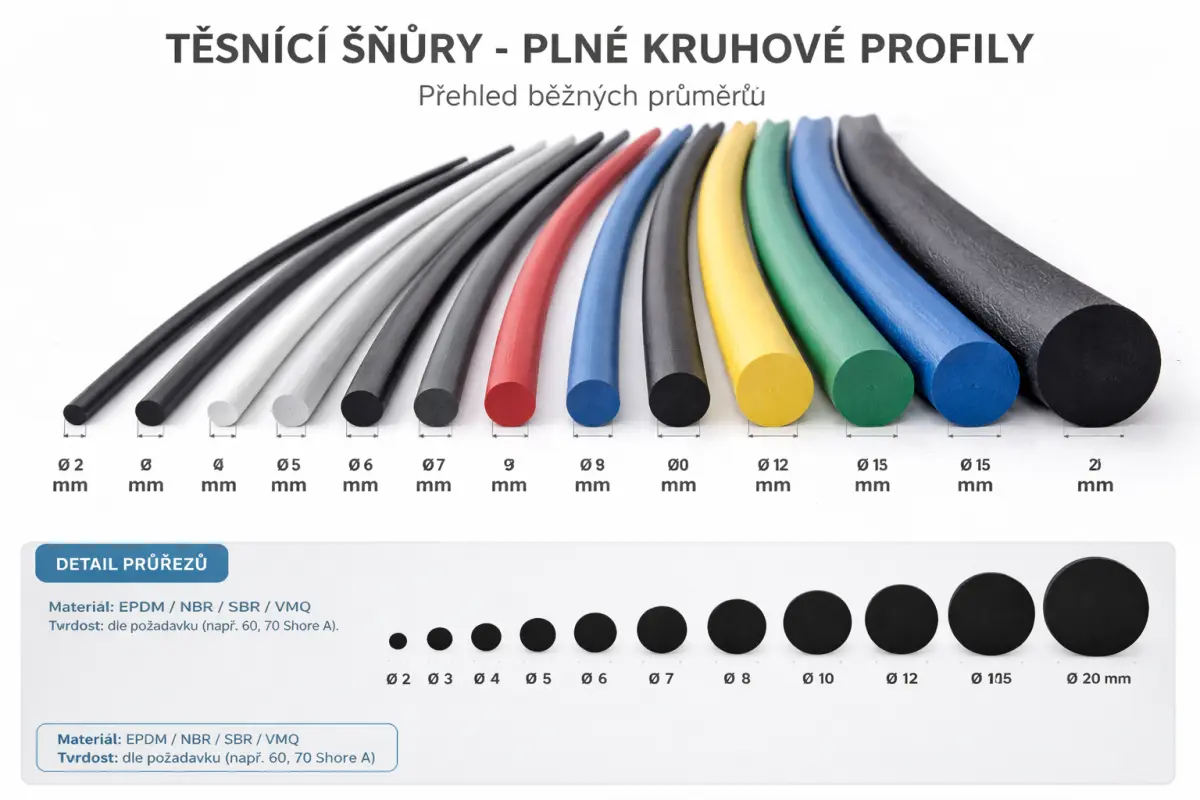
What are solid circle profiles cords?
Solid circle profilescords are solid (non-foamed) sealing elements with a circle cross-section, manufactured from various types of elastomers.
👉 Unlike microporous variants:
- they do not have a porous structure
- they are compact
- they have higher mechanical resistance
Key properties
✔ high elasticity
✔ good dimensional stability
✔ low water absorption
✔ long service life
✔ resistance resistance to pressure and deformation
Materials used
The choice of material is crucial:
🔸 EPDM
- resistance resistance to UV and weathering
- suitable for outdoor use
🔸 NBR
- oil resistance and fuels
- ideal for technical applications
🔸 silicone (VMQ)
- high temperature resistance
- suitable for the food industry
🔸 SBR
- cost-effective option
- general use
Dimension and variants
Solid circle profiles cords are manufactured in a wide range of diameter sizes:
- from approx. 2 mm up to 50 mm or more
- standard and bespoke lengths
- colour options available
How to choose the right line
When choosing, consider:
✔ diameter
it must fit the groove or joint
✔ hardness (Shore A)
- softer → better seal
- harder → higher resistance
✔ material
depending on the environment (heat, chemicals, UV)
Bespoke production
A major advantage is the option of bespoke production:
- precise diametery
- specific material
- required hardness
- specific colours
👉 the ideal solution for technically demanding projects
Modern trends
- eco-friendly materials
- Higher chemical resistance
- Tighter manufacturing tolerances
- Combination of materials
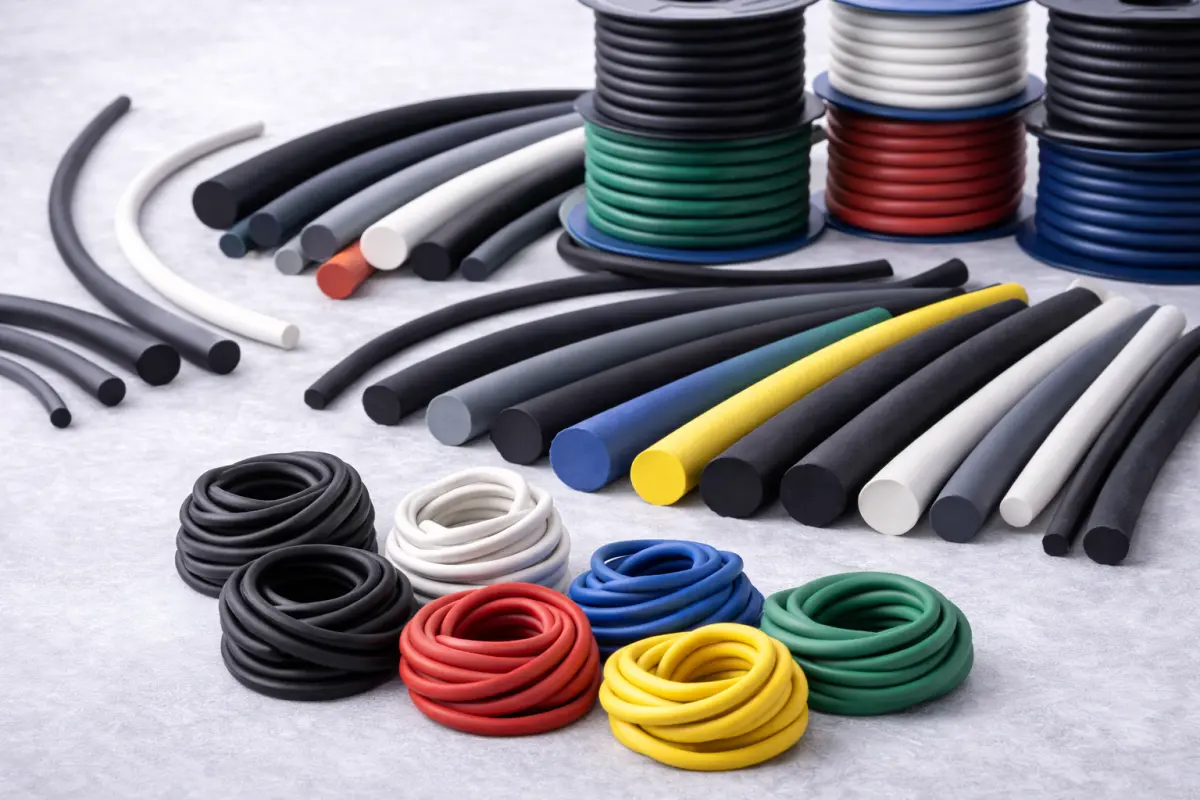
Interesting facts about the production of cords – solid circle profiles
Produced by extrusion (a continuous process)
Solid circle profiles cords are not produced in piece batches, but continuously by extrusion.
👉 This means:
- the material is extruded through a die (nozzle)
- an ‘endless cord’ is formed
- which is then cut to the required lengths
🔹 The accuracy of diameter is crucial
Tolerance plays a crucial role in seal.
👉 Standard tolerance:
- ±0.2 to ±0.5 mm (depending on diameteru)
➡️ Even a small deviation can affect the seal
🔹 The material is ‘cured’ during manufacture
Extrusion is followed by vulcanisation (curing):
- takes place at a high temperature
- changes the properties of the rubber
- increases strength and elasticity
👉 without this process, cord would be soft and unusable
🔹 Colour is not just about design
Coloured cords often have a practical significance:
- distinguishing between materials (e.g. EPDM vs. silicone)
- identification of hardnessi
- specific applications (e.g. the food industry)
🔹 Hardness is adjusted via the ‘formulation’
Hardness (Shore A) is not adjusted retrospectively, but is determined during the production of the compound.
👉 by changing:
- the ratio of fillers
- the type of rubberu
- additives
➡️ it is possible to achieve, for example, 40, 60 or 70 Shore
🔹 Joining into O-rings
Solid cords are often used to produce bespoke O-rings:
- cord is cut
- the ends are joined (by gluing or vulcanisation)
👉 ideal for non-standard dimensions
🔹 The surface can be finished
Cords do not always have to be smooth:
- they may be slippery (lower friction)
- textured
- or treated to prevent sticking
🔹 Each material behaves differently during manufacture
For example:
- silicone → very flexible, more challenging to shape
- EPDM → stable, versatile
- NBR → more sensitive to temperature during production
👉 therefore, the manufacturing process must be adjusted
🔹 Cooling affects quality
After vulcanisation, cord is cooled:
- too fast → deformation
- too slow → loss of precision
➡️ correct cooling = correct shape
🔹 Bespoke production is no problem
Thanks to extrusion, it is easy to customise:
- diameter
- colour
- hardness
- material
👉 which is why cords solid circle profiles are ideal for bespoke manufacturing
| +420 515 320 023 | ||
|
Mon–Thu 6:30–15:30 Fri 6:30–13:00 Lunch break 11:30–12:00 |
||
| [email protected] |
|
ADITEG, s. r. o. Vrbovec 321, 671 24 Znojmo |
