
Certificates

 Quality certificates – why are they important when choosing a supplier?

In manufacturing, construction and the automotive industry today, it is no longer enough simply to offer a high-quality product.

Customers are increasingly demanding proof of quality in the form of quality certificates, which confirm that the manufacturer meets strict requirements for production, inspection and the use of materials.

Whether you are purchasing rubber sheets, seal, technical rubber or anti-vibration components, certification provides assurance that the product meets the specified characteristics.
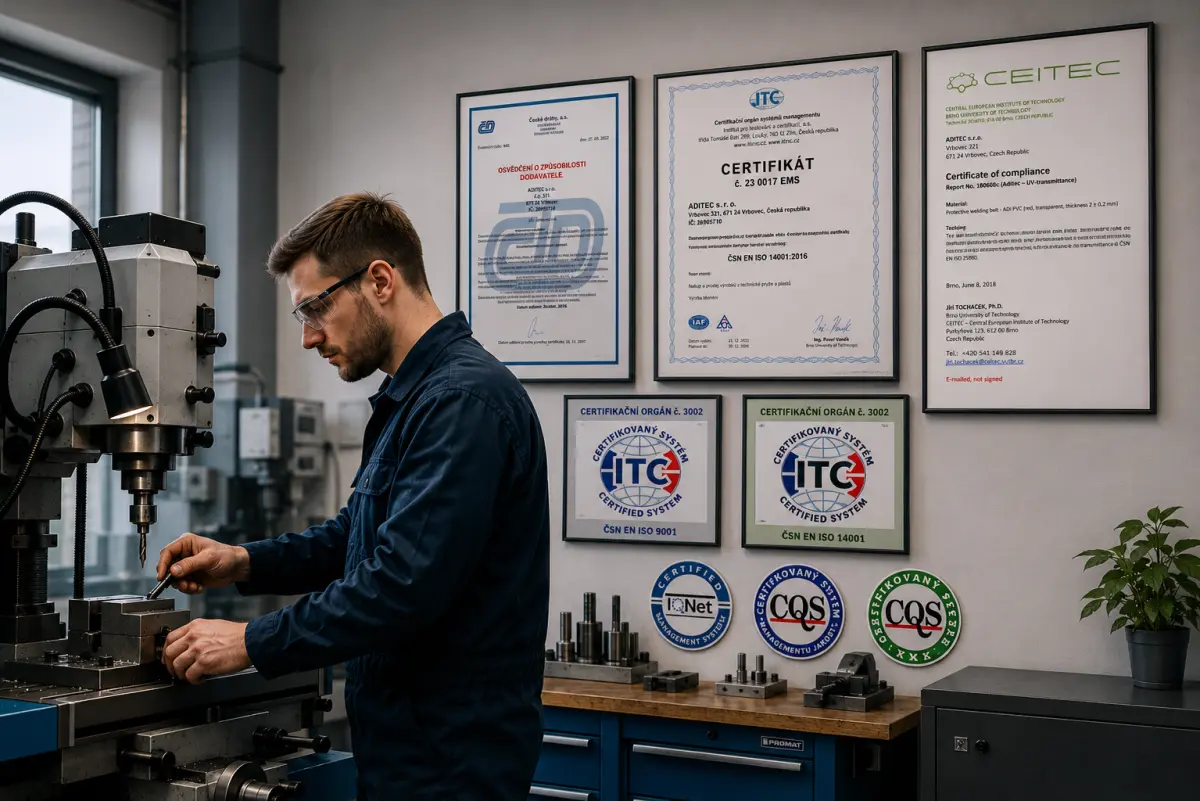
Aditeg certificates

What are quality certificates?

A qualitycertificate is a document issued by an independent certification body or an accredited laboratory. It confirms that a manufacturer or a specific product complies with established technical standards, safety requirements or legislative regulations.

For the customer, it provides an important guarantee that they are purchasing a product from a verified supplier.

Some of the best-known certifications include, for example:

  • ISO 9001 – quality management system
  • ISO 14001 – environmental management system
  • ISO 45001 – occupational health and safety
  • IATF 16949 – automotive industry
  • CE marking
  • REACH
  • RoHS
  • FDA
  • WRAS
  • DVGW
  • KTW
  • ACS
  • Drinking water certification

Why are certificates important?

Many companies today select suppliers based precisely on their level of certification. The reason is simple – a certified manufacturer must demonstrate, over the long term, that it adheres to precisely defined processes.

This means, for example:

  • consistent production quality,
  • regular product inspections,
  • production traceability,
  • proper handling of complaints,
  • staff training,
  • regular audits.

The result is a significantly lower risk of defective deliveries.


Material certification is not just a formality

In the case of technical rubbere, the material itself is often more important than the final product.

For example, a customer may require:

  • EPDM certified for drinking water,
  • silicone that meets FDA requirements,
  • oil-resistant NBR,
  • rubber certified for food contact,
  • a material compliant with REACH or RoHS.

Without the relevant documentation, it is not possible to verify these properties.
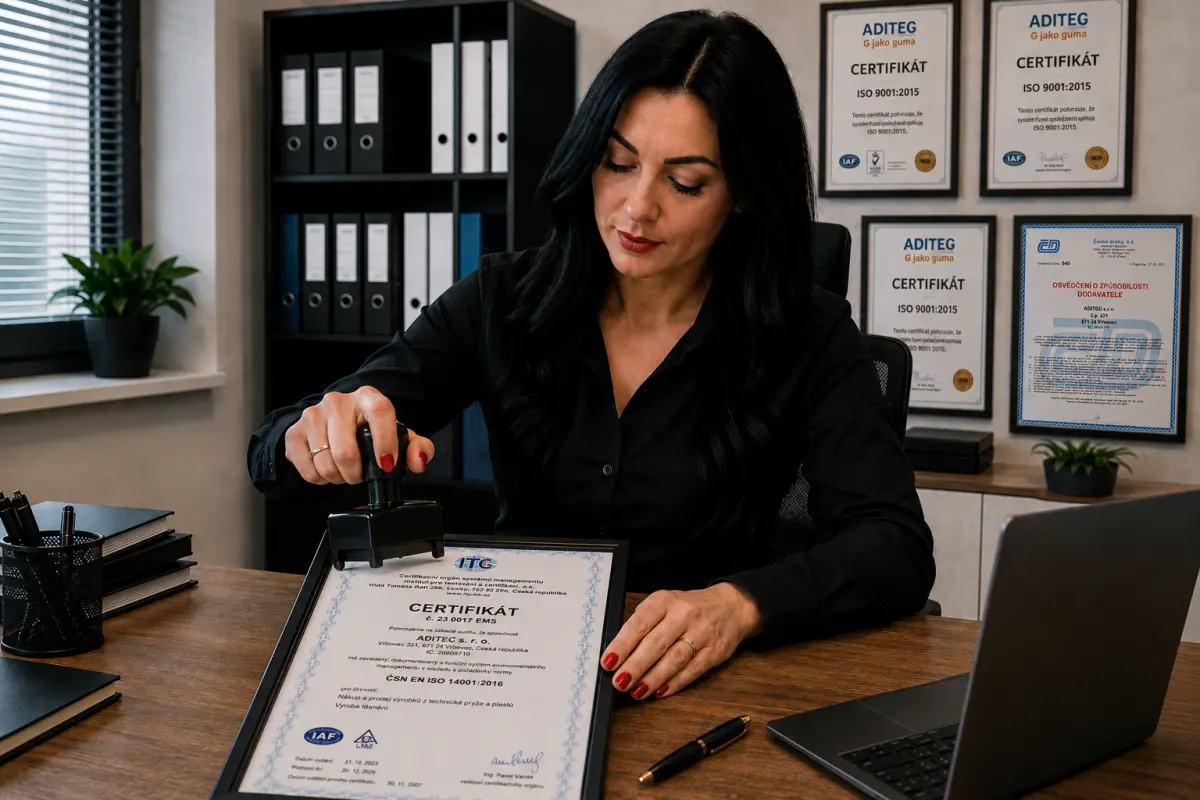
Aditeg certificates

 How does the certification process work?

Obtaining certification is a long-term process.

It usually involves:

  1. the implementation of a management system,
  2. developing production procedures,
  3. quality control,
  4. internal audit,
  5. an external audit by a certification body,
  6. regular surveillance audits.

Certification is therefore not a one-off process. In order for a company to retain its certificate, it must repeatedly demonstrate compliance with all requirements.


How can you recognise a reputable supplier?

A reputable manufacturer or supplier should be able to provide:

  • ISO certificates,
  • material leaves,
  • technical leaves,
  • safety leaves (SDS),
  • declarations of conformity,
  • material certificates,
  • test reports.

If the supplier does not provide these documents or is unable to produce them, it is advisable to be on your guard.


Certification in the manufacture of rubber products

Certification is of paramount importance in the manufacture of rubber and plastic components.

They are used, for example, in the manufacture of:

  • seal,
  • O-rings,
  • rubber plates,
  • anti-vibration washers,
  • silentblocks,
  • conveyor strips,
  • technical profiles,
  • industrial hoses.

In many sectors – such as the automotive, food or healthcare industries – certified materials are a prerequisite for use.


What are the benefits of certified products?

The use of certified products offers a number of advantages:

  • greater safety,
  • verified quality,
  • long service life,
  • better production traceability,
  • simpler claims handling,
  • compliance with legislative requirements,
  • greater customer confidence.

As a result, certified materials can save significant costs associated with complaints or production downtime.


Certification as a competitive advantage

Modern industry places ever-higher demands on product quality and traceability. Companies that invest in certification send a clear signal to customers that quality is not a matter of chance, but an integral part of their day-to-day processes.

When selecting a supplier, it is therefore not worth focusing solely on price. It is just as important to check whether the manufacturer holds the necessary certificates, technical documentation and experience.

High-quality certification represents an investment in reliability, safety and long-term cooperation.


What is the best-known quality certificate?

The most widely used is ISO 9001, which confirms that a company has an effective quality management system in place.

Are certifications mandatory?

Not all of them. Some are voluntary, whilst others are required by legislation or specific industrial sectors.

What is a material certificate?

It is a document confirming the properties of the material used, such as its chemical composition, hardness or mechanical para rubber properties.

What is the difference between a certificate and a safety leaf?

A certificate confirms compliance with a specific standard or requirement. A safety data sheet (SDS) contains information on the safe handling of chemical substances and mixtures.

Get in touch with us right now
We are available during the working week. Please send us your enquiry about a product or order using our quick form.
 *
 *
 *
 *
Fields marked with an asterisk are compulsory.
Give us a call
+420 515 320 023
Mon–Thu 6:30–15:30
Fri 6:30–13:00
Lunch break 11:30–12:00
Send an email
[email protected]
You can find us at the following address
ADITEG, s. r. o.
Vrbovec 321, 671 24 Znojmo
Navigate using Google Maps